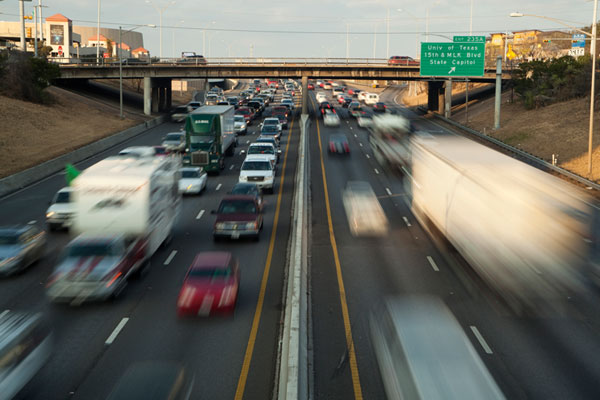
You aren't stuck in traffic. You are traffic.
Quick answer: "You aren't stuck in traffic—you are traffic" is a mindfulness lesson about perspective: the frustrations we blame on the world around us are systems we're part of. Zooming out from "everyone is in my way" to "we're all in this together" reduces road rage, judgment, and everyday resentment.
Austin drivers know the feeling: Mopac is a parking lot, someone's honking, and everyone else on the road seems to be the problem. But a single humbling street sign can flip that story on its head. Here's what one merge lane taught us about mindfulness, judgment, and being part of something bigger.
Why do we assume other drivers are the problem?
Because our default perspective puts ourselves at the center: the world is separate from us and imposing itself on us.
The story goes like this. Shortly after moving to a new part of town, one of our therapists kept taking a left turn onto the I-35 frontage road, always positioning himself in the far left lane so he'd have the right of way. One day another driver honked and "rudely" cut him off. Asshole! Then came the magnanimous self-talk: "I'll be the bigger man and let it go." Weeks later he finally noticed the street sign at that turn: Lane Ends—Merge Right. He'd been the one in the wrong the whole time—every "kind wave" to let right-lane drivers go ahead had been waving them into their own right of way.
What does "you are traffic" actually mean?
It means you're not a victim of the system—you're a participating cell in it, just like everyone else on the road.
When we see a line of ants, a flock of birds, or a school of fish, we naturally see an organized whole—a team. But behind the wheel, we see only separate, inconvenient individuals wasting our time. Try this: imagine yourself in your car, noticing every judgment about the drivers around you. Now slowly zoom out—above your car, above the freeway, until you can see the whole citywide web of interconnected roadways. Can you even find your car anymore? You are a single cell flowing down the veins of your city's infrastructure. You are traffic.
How does this perspective change daily frustration?
It replaces "me versus them" with "we're all in the same boat"—which softens anger in any situation where you have little control.
We are all trying to get somewhere. We all have time constraints. We all make mistakes. Research on driver self-perception has found that the vast majority of drivers rate themselves as more skilled than other motorists—even drivers who recently caused an accident. Turning that finger back on ourselves isn't about self-blame; it's about acknowledging that our problems are no more significant or urgent than anyone else's. Other people matter at least as much as we do. And sometimes it's your lane that's ending and your turn to merge right.
Why does this matter especially in Austin?
Because Austin's rapid growth makes traffic—and traffic frustration—a daily practice ground for mindfulness.
When this post was first written, Austin was gaining roughly 110 new residents every day and ranked among the worst U.S. cities for congestion—worse than New York, Boston, and Washington, D.C. The commute isn't going away. But every slow crawl down Mopac is a chance to practice the perspective shift that mindfulness-based therapy builds: noticing judgments, remembering interconnection, and choosing your response.
The bigger lesson behind the merge lane
The humbling truth is that we're rarely the innocent party we imagine ourselves to be—and we're never as separate from "everyone else" as we feel. Practicing that awareness in traffic trains it for the rest of life: work, family, and every other system we're part of. If everyday frustration or irritability is spilling into your relationships, individual counseling can help you respond differently.
Getting started. If anger, stress, or constant frustration is wearing you down, therapy can help you change your relationship with what you can't control. Our mindfulness therapy team in Austin can help.
Frequently asked questions
How can mindfulness help with road rage?
Mindfulness helps you notice angry judgments as they arise—before you act on them—and widens your perspective from "they're in my way" to "we're all part of the same flow."
Why do most drivers think they're better than average?
Self-serving bias: research cited in this post found that around 90% of drivers rate themselves as more skilled than other motorists, even after causing an accident. We judge others' mistakes harshly and excuse our own.
Can I practice mindfulness during my commute?
Yes. A commute is an ideal practice ground: notice your judgments, feel your hands on the wheel, and try zooming out to see yourself as one part of a larger whole.
Get started with a therapist at Austin Mindfulness Center—in person in Austin or online across Texas.
