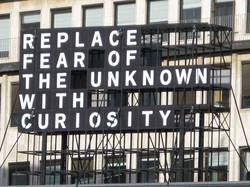
Embracing Ambiguity
Quick answer: Embracing ambiguity means learning to tolerate—and even appreciate—uncertainty instead of avoiding it. Our brains are wired to treat the unknown as a threat, so we suffer not only when things are bad, but when things merely might be bad. Making room for uncertainty opens the door to a fuller, more vital life.
Human suffering happens under two main conditions: when things are bad, and when things might be bad. The first is straightforward. The second is where much of our anxiety lives—we suffer over catastrophes that are only possibilities. Not just when we get dumped, but when we think we might get dumped. Here's why our minds work that way, and what embracing ambiguity can offer instead.
Why does uncertainty feel so threatening?
Because evolution favored the cautious: for our ancestors, treating an ambiguous shape in the distance as a bear rather than a blueberry bush was the safer bet.
Imagine two early humans on the savanna spotting a vague shape they can't make out. One assumes it's a blueberry bush and runs toward it; the other assumes it could be a bear and heads back to the cave. The optimist wins free lunch—until the day the shape really is a bear. Over time, natural selection passed along the cautious genes: what's bad is bad, what's ambiguous is also bad, and anything bad ought to be avoided. It's better to miss lunch than to be lunch.
How does avoiding uncertainty create suffering today?
We're no longer worried about bears, but our brains still treat emotional pain—and even the possibility of emotional pain—the same way they treated physical danger.
That avoidance shows up everywhere: the college student who stays in his dorm to avoid the risk of not fitting in, or the neglected spouse who stays in a loveless marriage because she's afraid of being lonely. Avoiding the unknown keeps the threat of pain at bay, but it can quietly become a prison of our own making.
Is certainty really as available as we think?
No—if you stacked everything you're certain about against everything you're uncertain about, the uncertainty pile would tower over the other.
And if each pile represented the scope of your vitality, which would you rather live in? Many of us choose the limited scope anyway. Even when an abundant life is rife with possibilities for adventure, passion, and love, we'll trade it away for some good old certainty. Predictable walls feel safe, but they also keep out most of what makes life worth living.
What does it mean to embrace ambiguity?
It means opening up to uncertainty, appreciating it, and asking what it has to offer that certainty does not.
Psychologist Kelly Wilson, in his book Mindfulness for Two, puts it this way: "Most of the things in life we truly care about are very ambiguous, and if we can't tolerate ambiguity, we are doomed to act in the service of its elimination." Love, meaningful work, growth—none of them come with guarantees. Learning to sit with the unknown, a core skill in mindfulness-based therapy, frees you from spending your life trying to eliminate it. What more might you experience if you weren't consumed with efforts to escape the unknown?
Living with the unknown
Uncertainty isn't going anywhere—our brains simply evolved to dislike it. The choice we do have is whether to organize our lives around avoiding ambiguity or to open up to it and reclaim the adventure, connection, and vitality on the other side. If worry about what might happen is running your life, anxiety counseling can help you build a different relationship with the unknown.
Getting started. If intolerance of uncertainty is keeping your life small, working with a therapist can help you loosen its grip. Our anxiety counseling team in Austin can help.
Frequently asked questions
Why do I worry about things that haven't happened?
Your brain evolved to treat ambiguity as a potential threat—for our ancestors, over-caution was safer than optimism. That wiring means we suffer over possibilities, not just realities.
Is avoiding uncertainty always a bad thing?
Caution has its place. The problem comes when avoiding the unknown shrinks your life—keeping you from relationships, opportunities, and experiences you actually value.
Can therapy help me tolerate uncertainty better?
Yes. Mindfulness-based approaches teach you to notice anxious predictions without obeying them, and to act on your values even when outcomes aren't guaranteed.
Get started with a therapist at Austin Mindfulness Center—in person in Austin or online across Texas.
